Technical depth & production fluency
Full-stack fundamentals, APIs, cloud, data, debugging, production judgement and practical AI fluency where relevant.

The Balncs Benchmark is a role-specific competency model for comparing forward-deployed talent across technical depth, customer discovery, problem decomposition, judgement and outcome ownership.
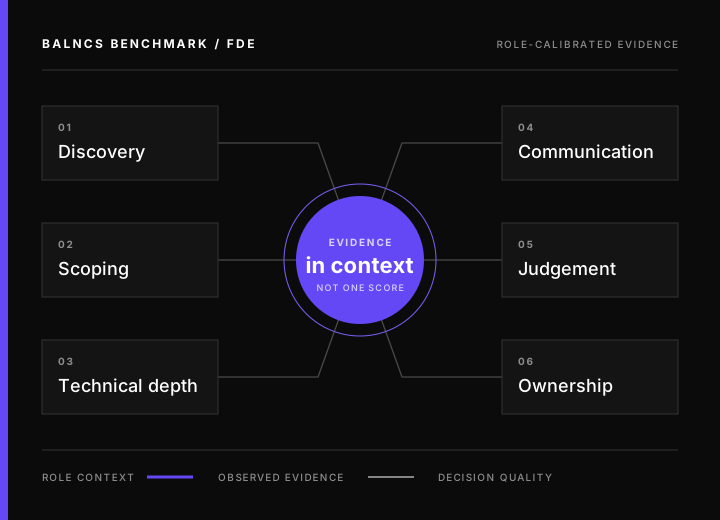
The 13-page guide explains role calibration, the six evidence dimensions, four evidence levels, weighting, evidence collection, illustrative outputs and responsible-use limits.
The model is designed to create more consistent evidence across hiring managers while still leaving room for role-specific weighting.
Full-stack fundamentals, APIs, cloud, data, debugging, production judgement and practical AI fluency where relevant.
Breaking an ambiguous customer problem into constraints, assumptions, technical workstreams and a sequenced path to value.
Listening, questioning, stakeholder management, technical explanation and the ability to build trust without overpromising.
Making trade-offs between scope, speed and quality; removing blockers; driving adoption; and staying accountable to the actual result.
The Benchmark is not intended to turn people into a single number. It creates a structured discussion around specific examples and the context in which they occurred.
A polished answer is not the same as demonstrated capability. We look for increasing levels of direct ownership and complexity.
| Level | Signal | Example evidence |
|---|---|---|
| Exposure | Participated | Worked on a customer deployment with defined tasks and close support. |
| Ownership | Led a workstream | Scoped a technical component, made trade-offs and delivered it into production. |
| End-to-end | Owned the deployment | Ran discovery, designed the approach, built or coordinated implementation and drove adoption. |
| Multiplier | Improved the system | Converted field learning into reusable product patterns, tooling, playbooks or a stronger operating model. |
This example shows the level of evidence and decision context the model is designed to capture. It is illustrative, not a real candidate assessment.
| Dimension | Observed evidence | Evidence level | Hiring implication |
|---|---|---|---|
| Technical depth | Designed an API integration, diagnosed production failures and improved observability. | Ownership | Strong for a scoped deployment; test architecture depth for larger systems. |
| Discovery & scoping | Converted conflicting stakeholder requests into constraints, milestones and explicit exclusions. | End-to-end | Can lead ambiguous discovery with limited structure. |
| Customer communication | Reset expectations after a missed milestone and preserved sponsor trust through a recovery plan. | End-to-end | Evidence of candour and executive-facing judgement. |
| Outcome ownership | Tracked adoption after launch and converted repeated deployment work into reusable tooling. | Multiplier | Potential to improve both customer outcomes and the deployment system. |
Ratings are anchored to evidence, then weighted against the calibrated role. The Benchmark is a decision aid rather than a psychometric test, certification or guarantee of job performance.
The model creates structure around human judgement. It helps different interviewers compare the same evidence and be explicit about the trade-offs they are accepting.
Agree what “strong” means before interviewing begins.
Review comparable evidence across people with different titles and backgrounds.
Understand where a candidate is exceptional and where the team will need to support them.
Use the Benchmark as part of a Balncs search or as a standalone calibration exercise for an existing process.